Smart Factory Automation Approaches for Canadian Manufacturers in 2026
Canadian manufacturing has entered a phase where automation is no longer a side project for large plants with deep capital budgets. It has become an operating discipline. By 2026, the conversation is less about whether to automate and more about where automation will create the fastest, safest, and most durable gains. That shift matters in Canada because the pressures are distinct: high labour costs relative to many offshore competitors, persistent skills shortages in maintenance and controls, a wide spread of plant sizes, strong exposure to food processing, automotive, metals, packaging, wood products, and a climate that can punish fragile infrastructure in ways people outside the country often underestimate.
Walk through enough Canadian facilities and a pattern emerges. Very few plants need a glossy vision of a lights-out factory. Most need a practical sequence of improvements that stabilizes output, reduces unplanned downtime, improves traceability, and helps supervisors make better decisions on the floor. The best smart factory programs do exactly that. They connect operations, maintenance, quality, and planning without turning the plant into a science experiment.
That is where industrial automation Canada is heading in 2026. Not toward hype, but toward disciplined execution. The winners are combining proven controls, stronger data collection, targeted robotics, machine vision, condition monitoring, and more thoughtful integration between machines and business systems. They are also getting more selective. Rather than trying to automate everything, they pick bottlenecks, safety risks, repetitive handling tasks, and high-cost quality failures first.
What “smart factory” actually means on a Canadian plant floor
The phrase gets stretched too far. In practice, a smart factory is a plant where automation systems do more than run machines in isolation. They share trustworthy data, react to changing conditions, and support decisions in real time. Sometimes that means a packaging line that automatically adjusts to product variation based on sensor feedback. Sometimes it means an injection molding cell that flags drift in cycle time before scrap rises. Sometimes it is as plain as giving a maintenance team a reliable dashboard that tells them which assets are running hot, which VFD is faulting more often, and which line stops are costing the most.
The smartest facilities are not necessarily the most automated. They are the most coherent. Their factory automation investments fit the process, the people, and the production economics. A highly variable job shop will not automate the same way an Ontario food processor or an Alberta fabrication plant will. That sounds obvious, but it gets ignored when organizations buy technology before defining the production problem.
In 2026, the stronger manufacturing automation strategies in Canada share three traits. They solve a real operational pain point, they can be maintained by the team that inherits them, and they produce data that people trust enough to act on. Without those three conditions, even sophisticated industrial automation solutions become expensive islands.
Why Canadian manufacturers are approaching automation differently
The Canadian context changes the math. Energy costs, provincial incentives, export exposure, bilingual operations in some facilities, and seasonal supply chain disruptions all affect the business case. So does geography. A plant in southern Ontario may have easier access to systems integrators, robot technicians, and spare parts than a facility in northern Quebec or central Saskatchewan. When support is far away, maintainability becomes more important than feature depth.
Labour is another decisive factor. Many plants are not replacing large numbers of workers with automation. They are trying to keep lines running when they cannot reliably staff difficult positions. End-of-line palletizing, repetitive machine tending, washdown-area handling, and visual inspection remain common starting points because those are jobs where turnover, ergonomic strain, and quality variation can pile up quickly.
There is also a maturity issue. Plenty of Canadian facilities still have a mix of legacy PLCs, standalone HMIs, spreadsheet-based downtime tracking, and fragmented quality records. For those plants, the first smart factory move is not a mobile robot fleet. It is often standardizing controls, improving industrial networking, adding historians or MES functions where they fit, and cleaning up data tags so the production story matches what the line is actually doing.
That foundational work rarely makes for flashy case studies, but it is where a lot of value lives.
The 2026 automation stack: less glamour, more performance
If you ask plant managers what they regret, you hear versions of the same story. They bought equipment with too many custom features, too little documentation, or controls nobody on staff could troubleshoot at 2:00 a.m. A smart factory in 2026 avoids that trap by building around an automation stack that can survive real production conditions.
At the machine level, sensors have become cheaper and more useful, but the real gain comes from applying them selectively. Vibration, current draw, temperature, flow, torque, and vision data can all be valuable. Yet more signals do not automatically mean more insight. If the maintenance team never uses the trend data https://griffinjtmx647.almoheet-travel.com/machine-tending-solutions-that-improve-safety-and-throughput or the alarms are poorly configured, the plant simply creates noise. The strongest implementations start with one question: what failure or loss are we trying to see earlier?
At the control level, modern PLC and IPC environments make it easier to integrate motion, safety, and recipe management, but standardization matters more than novelty. Plants that reduce the variety of controls platforms across their operation usually see better uptime over time because troubleshooting becomes faster, spare parts management improves, and internal training gets easier.
At the supervisory level, the conversation has matured. Manufacturers are more cautious about enterprise software that promises everything. They want MES, SCADA, historian, OEE, and quality tools that fit their operating model, not just their procurement process. For a high-mix manufacturer, rigid workflow software can create as many workarounds as it eliminates. For a continuous process facility, real-time visibility and deviation management may matter more than exhaustive digital paperwork.
At the analytics level, interest remains strong, but skepticism has sharpened. Plants want useful alarms, reliable downtime coding, and actionable maintenance indicators. They do not want dashboards that impress visitors and confuse supervisors. That is healthy. Good industrial automation solutions should shorten the gap between event and action.
Where factory automation is paying off fastest
In Canadian plants right now, the highest-return projects tend to live in a few recurring zones.
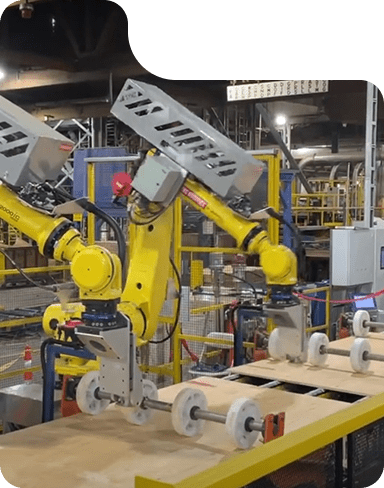
Robotic palletizing and depalletizing remain attractive because they address labour instability, repetitive strain, and line consistency at once. The economics are especially compelling where case weights are high, shifts are long, and line throughput is stable enough to justify integration. The challenge is not usually the robot itself. It is product variability, floor space, upstream reliability, and end-of-line congestion. A palletizer starves or blocks if the rest of the line is not balanced.
Machine vision has also become more practical, especially for inspection tasks that humans perform inconsistently over a full shift. Label verification, presence-absence checks, fill-level inspection, simple cosmetic defect detection, and package orientation are all common applications. The catch is that vision should not be expected to compensate for an unstable process. If lighting changes, product presentation is inconsistent, or reject handling is sloppy, performance falls off quickly. Vision works best when paired with sound mechanical design and clear quality standards.
Automated material handling is advancing, but with mixed results. Autonomous mobile robots and AGVs can add flexibility in some plants, particularly where traffic patterns are predictable and labour for repetitive internal moves is scarce. In cramped facilities with uneven floors, heavy congestion, or frequent path changes, the benefits can narrow. Canadian manufacturers with older buildings need to assess layout realities carefully. A warehouse built for forklifts and improvisation does not become a smooth autonomous environment overnight.
Process automation is often the sleeper opportunity. In food, chemicals, water-intensive operations, wood products, and certain metals applications, improved control loops, recipe automation, batching accuracy, and energy management can deliver larger and more reliable savings than visible robotics. Better process control reduces giveaway, waste, rework, and variability. It also tends to be easier to justify because it affects every shift, not just one cell.
Data collection is not the goal, usable data is
One of the most common mistakes in manufacturing automation is treating connectivity as success. It is easy to connect machines. It is harder to define signals consistently across assets, map them to meaningful events, and build enough trust that production and maintenance teams use the information every day.
A good example is downtime tracking. Many plants say they want OEE, but the first version often fails because stop reasons are vague, operators select whatever gets them back to running fastest, and minor stops never get coded accurately. After a few months, management sees charts, but no one believes the root causes. The remedy is simple in principle and demanding in practice: tighten the definitions, automate what can be detected automatically, and review data on the floor with the people who live with it. When the same three stop categories keep surfacing and everyone agrees they are real, improvement begins.
Traceability follows the same pattern. More Canadian manufacturers need lot genealogy, quality records, and customer-specific compliance data than they did a decade ago. That need is particularly visible in food processing, regulated manufacturing, and export-focused sectors. The smart approach is not to digitize every form blindly. It is to identify the records that matter during an audit, a recall, or a customer complaint, then structure capture at the point of activity. If operators need six screens to complete a two-minute task, the system will be bypassed or filled in later, neither of which helps.
Cybersecurity has moved from IT concern to production risk
By 2026, any serious factory automation strategy in Canada has to include operational technology security from the beginning. Plants that once viewed cybersecurity as an office-network issue have learned that production systems can be disrupted by weak remote access controls, unmanaged laptops, flat networks, and outdated firmware sitting quietly on essential equipment.
The practical challenge is that manufacturing sites cannot treat OT exactly like IT. Patch windows are limited. Legacy equipment may not tolerate modern security tools gracefully. Vendors still need access for support. The right stance is risk-based, not absolutist. Segment the network, manage remote access tightly, maintain current asset inventories, and define who can change what in production systems. Most of the value comes from discipline, not heroics.
This is one area where a lot of projects get delayed for good reason. If a new machine arrives with opaque remote-access methods, default credentials, and weak documentation, integration should slow down until those issues are addressed. Fast commissioning is attractive, but not if it introduces long-lived vulnerabilities into an operation that depends on uptime.
Integration is where projects succeed or fail
Manufacturers often talk about automation as if it were mainly an equipment purchase. In reality, the work that determines outcomes is integration. Machines need to talk to line controls, line controls need to report to supervisory systems, quality events need context, and business systems need enough production truth to support planning and fulfillment.
Poor integration creates daily friction. Operators enter the same data twice. Recipes are updated in one place and missed in another. Maintenance sees faults without production context. Quality teams reconstruct events after the fact. Each gap seems small until the plant scales or a customer issue exposes the blind spots.
Strong integration work starts with process mapping, not software selection. What event starts the transaction? Who confirms it? What data matters at that point? Where does the master record live? Which exception requires human review? Those questions sound mundane, but they prevent months of rework later.
For Canadian firms with multiple plants, there is an added tension between standardization and local reality. Corporate teams want common KPIs and architectures. Site teams need flexibility because their equipment base, staffing, and product mix differ. The best organizations define standards where consistency pays off, naming conventions, cybersecurity policy, core reporting, data ownership, then allow local adaptation at the machine and workflow level where process differences are genuine.
The business case has become more disciplined
In the past, some automation proposals survived on broad claims about modernization. That no longer carries much weight. Capital is expensive enough, and operational expectations are sharp enough, that 2026 business cases need to be specific.
A credible automation case usually combines several value streams. Labour reduction by itself may not justify the spend, especially if workers can be redeployed rather than removed. But pair labour stability with scrap reduction, throughput improvement, injury risk reduction, lower changeover time, and better schedule adherence, and the economics strengthen quickly. A palletizing cell, for instance, may reduce manual handling exposure, free operators for upstream tasks, improve stacking consistency, cut product damage, and make weekend shifts easier to staff. That is a stronger argument than headcount arithmetic alone.
The same goes for predictive or condition-based maintenance tools. Very few plants save money because a dashboard exists. They save money because one avoided bearing failure prevents a line shutdown during a critical production window, or because maintenance plans become more targeted and overtime falls. A plant that cannot translate signals into work orders, inspections, or repair decisions will not see the return.
There is also a financing reality. Some midsize manufacturers are staging investments more deliberately, using pilot cells, modular controls upgrades, or line-by-line deployment rather than a full-plant transformation. That can be wise, provided the architecture supports scaling. A pilot that proves value but cannot connect cleanly to the rest of the operation is an expensive detour.
Where companies should start, and where they should not
Plants often ask for a roadmap, but the answer depends on operational pain. Still, a few patterns show up often enough to be useful.
The right first project is usually visible, measurable, and painful. It has a clear baseline and a manageable integration boundary. A chronic bottleneck, a repetitive manual handling area, a quality check with known misses, or a high-failure utility asset usually makes more sense than a broad platform rollout with vague goals.
On the other hand, there are poor starting points. Do not begin with a complex multi-line integration if your tag naming is chaotic and no one agrees on how to define runtime. Do not launch a vision project where product presentation is unstable and mechanical fixes have been deferred. Do not install advanced analytics before the underlying sensors, state logic, and maintenance response process are credible.
A short readiness check can keep a team honest:
- Is the target process stable enough to automate without constant exception handling?
- Can the plant support the chosen controls and automation systems after commissioning?
- Are baseline losses measured well enough to prove improvement?
- Is there a clear owner across operations, maintenance, quality, and IT or OT?
- Will the project produce data people can trust and use daily?
If several of those answers are no, the smartest move is often a narrower preliminary project.
The people side is still the hard part
Technology can be bought. Operating change has to be built. Many automation programs struggle because leaders underestimate the effect on supervisors, operators, maintenance technicians, and planners. A line that becomes more automated changes how work is done even if no jobs disappear. Operators may handle exceptions rather than continuous manual tasks. Maintenance may shift from reactive troubleshooting to more software, networking, and instrumentation work. Supervisors may need to manage through data they did not have before.
That transition creates friction if training is shallow or rushed. It also creates resistance when teams believe automation is being used to judge them rather than support them. The best projects involve the people closest to the process early, not after the purchase order is issued. They know where jams occur, which alarms are meaningless, which changeovers always run long, and which workarounds keep production alive. Ignore that knowledge and the system will reflect assumptions instead of reality.
One food plant manager described it well after an end-of-line automation project. The robot itself was the easy part, he said. The hard part was teaching three shifts to recover cleanly from minor faults without calling maintenance every time, and making sure upstream operators understood how their case quality affected palletizer uptime. That comment captures the truth. Automation is a team sport long after startup.
Sector-specific patterns across Canadian manufacturing
Different industries are moving at different speeds and for different reasons. Food and beverage continues to invest heavily where traceability, hygiene, labour availability, and packaging efficiency intersect. Washdown-rated equipment, vision inspection, recipe control, and end-of-line robotics are especially common here, though sanitation and product variability can complicate design more than vendors admit.
Automotive and automotive suppliers remain strong users of advanced automation, but even there the emphasis has shifted from raw automation density to resilience, flexibility, and data quality. Changeovers, traceability, and quality containment still dominate investment logic.
Wood products and building materials have often focused on rugged automation, saw optimization, sorting, process stabilization, and condition monitoring. Harsh environments and legacy assets make maintainability crucial. Fancy software layered on unreliable instrumentation does not last long in these facilities.
Metals, fabrication, and general industrial manufacturers show the widest spread. Some are embracing robotic welding, machine tending, and digital production tracking. Others are still at the stage where standard work, basic machine connectivity, and disciplined scheduling offer larger gains than advanced technology.
That diversity is why industrial automation solutions must fit operating reality. There is no universal Canadian playbook.
What a sensible 90-day automation planning cycle looks like
When a manufacturer is serious about moving forward, the first three months matter more than the first software demo. This early phase should narrow scope, test assumptions, and build a project the plant can actually absorb.
- Spend time at the process, not just in meeting rooms. Watch shifts change, observe jams and micro-stops, and talk to operators and maintenance on all crews.
- Establish a baseline with real numbers. Throughput, scrap, changeover loss, downtime categories, labour exposure, and quality misses should be clear enough to anchor the business case.
- Review infrastructure honestly. Network coverage, panel space, controls age, spare parts exposure, and cybersecurity gaps can change the project shape significantly.
- Define support ownership before approval. Decide who will own recipes, backups, user access, alarm strategy, spare parts, and post-startup tuning.
- Choose an integration partner with relevant process experience, not just generic controls capability. The difference shows up during exceptions and startup pressure.
That cadence sounds simple because it is. It is also the stage most likely to be rushed, which is why so many projects inherit avoidable problems.
The shape of smart manufacturing in Canada over the next few years
By 2026, the strongest Canadian manufacturers are no longer chasing the idea of total automation. They are building selective intelligence into the plant. That means more standardized controls, more dependable plant-floor data, more automation around constrained labour tasks, tighter integration between operations and quality, and more disciplined attention to cybersecurity and maintainability.
There will still be ambitious greenfield projects and highly automated cells, especially in sectors with stable products and large volumes. But the bigger story is happening in brownfield environments. Existing plants are being upgraded in layers. A packaging line gets vision and reject verification. A process area gets improved instrumentation and tighter control logic. A manual palletizing station becomes robotic. A historian finally exposes chronic minor stops. An old line gains standardized HMIs and remote diagnostics done properly. None of those steps sounds dramatic on its own. Together, they change output, reliability, and management confidence.
That is what smart factory automation looks like for most Canadian manufacturers now. It is practical, cumulative, and tightly tied to production economics. The companies that do it well are not the ones buying the most technology. They are the ones matching factory automation to real plant constraints, backing it with solid automation systems, and insisting that every layer, from sensor to schedule, serves the operation rather than distracting from it.
Sync Robotics Inc. — Business Info (NAP)
Name: Sync Robotics Inc.Address: 2-683 Dease Rd, Kelowna, BC V1X 4A4
Phone: +1-250-753-7161
Website: https://www.syncrobotics.ca/
Email: [email protected]
Sales Email: [email protected]
Hours:
Monday: 8:00 AM – 4:30 PM
Tuesday: 8:00 AM – 4:30 PM
Wednesday: 8:00 AM – 4:30 PM
Thursday: 8:00 AM – 4:30 PM
Friday: 8:00 AM – 4:30 PM
Saturday: Closed
Sunday: Closed
Service Area: Kelowna, British Columbia and across Canada
Open-location code (Plus Code): VHWR+PQ Kelowna, British Columbia
Map/listing URL: https://maps.app.goo.gl/xwtV2wEu8ZuKH3se8
Embed iframe:
Socials (canonical https URLs):
LinkedIn: https://www.linkedin.com/company/syncrobotics/
Instagram: https://www.instagram.com/syncrobotics/
Facebook: https://www.facebook.com/syncrobotics/
https://www.syncrobotics.ca/
Sync Robotics Inc. is an industrial robot and controls integration company based in Kelowna, British Columbia.
The company designs and deploys automation solutions for manufacturing operations across Canada.
Services include industrial robotics integration, controls integration, automation system design, deployment support, and related manufacturing automation solutions.
Sync Robotics Inc. is located at 2-683 Dease Rd, Kelowna, BC V1X 4A4.
To contact Sync Robotics Inc., call +1-250-753-7161 or email [email protected].
For sales inquiries, email [email protected].
Hours listed are Monday to Friday 8:00 AM–4:30 PM, with Saturday and Sunday closed.
For directions and listing details, use the map listing: https://maps.app.goo.gl/xwtV2wEu8ZuKH3se8
Popular Questions About Sync Robotics Inc.
What does Sync Robotics Inc. do?Sync Robotics Inc. designs and deploys industrial robot and controls integration solutions for manufacturing operations.
Where is Sync Robotics Inc. located?
Sync Robotics Inc. is located at 2-683 Dease Rd, Kelowna, BC V1X 4A4.
Does Sync Robotics Inc. serve clients outside Kelowna?
Yes—Sync Robotics Inc. is based in Kelowna, British Columbia and serves clients across Canada.
What are Sync Robotics Inc.’s hours?
Monday–Friday: 8:00 AM–4:30 PM; Saturday and Sunday closed.
How can I contact Sync Robotics Inc.?
Phone: +1-250-753-7161
General Email: [email protected]
Sales Email: [email protected]
Website: https://www.syncrobotics.ca/
Map: https://maps.app.goo.gl/xwtV2wEu8ZuKH3se8
LinkedIn: https://www.linkedin.com/company/syncrobotics/
Instagram: https://www.instagram.com/syncrobotics/
Facebook: https://www.facebook.com/syncrobotics/
Landmarks Near Kelowna, BC
1) Kelowna International Airport2) UBC Okanagan
3) Rutland
4) Orchard Park Shopping Centre
5) Mission Creek Regional Park
6) Downtown Kelowna
7) Waterfront Park